
A Practical AnswerAtlas AI-Search Workflow
Use AnswerAtlas to audit Shopify catalog readiness, prioritize product and context fixes, and monitor observed endpoint signals carefully.
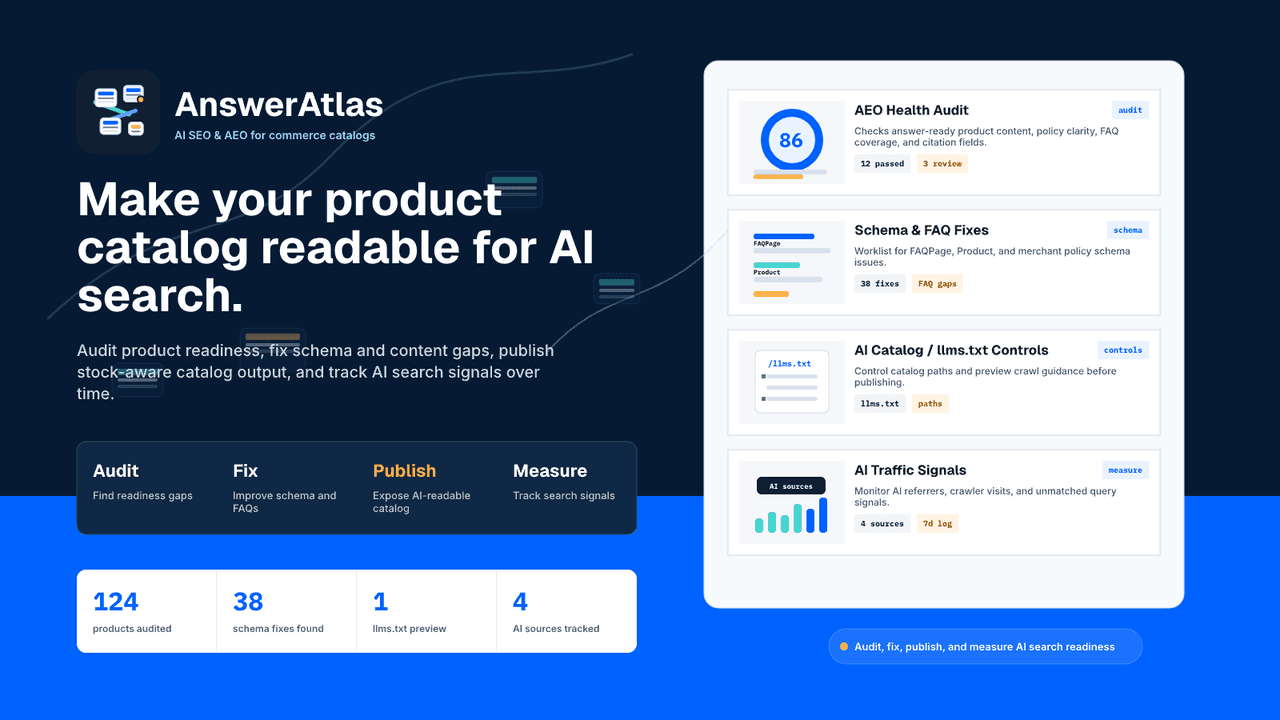
AnswerAtlas helps Shopify teams audit how clearly product and brand information is prepared for AI-assisted search and discovery systems. A practical workflow is to establish the catalog context, run the readiness audit, prioritize specific findings, apply changes, and then review audit progress alongside observed endpoint signals.
The workflow does not guarantee rankings, citations, crawler behavior, traffic, conversions, or revenue. It is a structured way to identify and improve information that may help external systems interpret a catalog.
Prepare the catalog context first
Before running an audit, identify the catalog areas that matter most to the business. That may include important products, collections, brand information, policies, and frequently asked questions.
Review whether the source information is already clear:
- Product titles describe the item rather than relying only on internal naming.
- Descriptions include concrete facts a buyer or system would need.
- Variants, availability, and core attributes are represented consistently.
- Collection relationships make sense.
- Brand and policy information can be found from relevant pages.
The goal is not to rewrite everything before the audit. It is to understand which parts of the catalog should receive attention first.
Run the readiness audit
Install AnswerAtlas from the official Shopify App Store listing, connect the store catalog, and run an AI-search readiness audit.
The published product workflow organizes findings into a readiness score, component health, priority actions, and product-level issues. Use the score as an orientation tool, not as a promise about external search results.
Start by separating findings into practical groups:
- Product-content gaps.
- Structured-data issues.
- Technical or exposure blockers.
- Missing entity, brand, or catalog context.
Grouping findings helps the team assign work to the people who can actually resolve it.
Prioritize changes by impact and effort
Do not begin with the longest list. Begin with issues that affect important catalog areas and can be corrected with clear evidence.
A simple prioritization sequence is:
- Fix blocking technical or structured-data errors.
- Correct missing or inconsistent product facts.
- Improve thin descriptions and FAQs where they support buyer decisions.
- Strengthen relationships among products, collections, and brand information.
- Review lower-priority refinements after the core catalog is coherent.
Document what changed so the next audit can be interpreted against actual work rather than memory.
Rerun the audit after meaningful changes
Rerun the audit after a coherent batch of changes. Rechecking after every small edit can make it harder to understand which work affected the findings.
Compare:
- whether critical findings were resolved,
- which products still lack context,
- whether new issues appeared,
- which recommendations remain outside the current project scope.
The purpose is to create a repeatable improvement cycle, not to chase a perfect score without regard to the catalog.
Interpret observed endpoint signals carefully
AnswerAtlas Traffic Lite reports requests observed at AnswerAtlas-managed endpoints and provides source and trend views. These signals describe observed activity only.
They should not be treated as:
- a complete count of AI crawler activity,
- an estimate of all AI-search visibility,
- proof that a product was cited or recommended,
- a guaranteed link to traffic, conversions, or revenue.
Use the signals as one input alongside audit history, catalog changes, marketplace information, and the team's own business measurements.
Workflow review checklist
- Important products and collections are identified.
- The first audit has been saved or documented.
- Findings are grouped by content, structured data, technical issues, and context.
- Priority changes have an owner.
- Product facts remain accurate after edits.
- The audit is rerun after a meaningful change set.
- Observed signals are described with the correct limitations.
- Current pricing and terms are checked on the official Shopify listing.
Review the full AnswerAtlas catalog page for audience fit, trust responsibilities, verified product facts, and official resources. For the website measurement approach, read Privacy and Respectful Measurement at NAU Apps.